
3 Marla Plot Scheme 2025
3 Marla Plot Scheme 2025 Punjab government has officially launched the 3 Marla Plot Scheme 2025 under the “Apni Zameen Apna Ghar” initiative to offer free residential plots to low-income families across the province. This program is designed to support people who have long struggled with rising housing costs and have no ability to purchase land on their own. For thousands of families, this scheme represents a major step toward stability, security, and a permanent home. The online portal has made the entire process transparent and accessible without involving middlemen or manual applications.
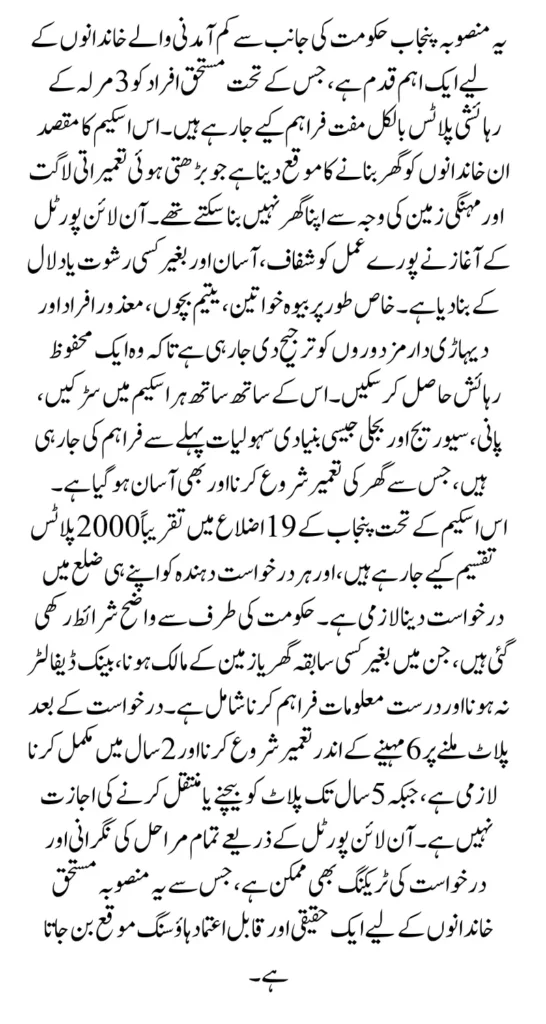
The scheme’s focus is on individuals who truly need government assistance. Widows, orphans, disabled persons, and daily wage laborers are given priority to ensure the most vulnerable communities receive dedicated support. Moreover, each plot comes with approved development features like paved roads, sewerage, water supply, and access to electricity, enabling households to begin construction as soon as possession is granted.
You Can Also Read: UAE National Day 2025
Key Features of the 3 Marla Plot Scheme
The 3 Marla Plot Scheme carries a number of unique features that make it different from previous housing projects in Punjab. The initiative ensures that all eligible low-income families receive a completely free residential plot, removing the financial obstacles that often prevent them from owning property. Another important advantage is government assurance of basic infrastructure, allowing allottees to construct their homes without worrying about utilities or essential services.
Beyond this, the scheme is designed in phases to cover more districts over time. Phase 1 includes nearly two thousand plots in 19 districts, and Phase 2 is planned to expand further based on land availability and demand. This structured expansion model ensures fairness and balanced distribution across the province. Female-headed households and marginalized families are also prioritized to support social inclusion and gender empowerment.
Key Benefits at a Glance
- Free 3 Marla (675 sq. ft.) residential plots
- Basic infrastructure guaranteed
- Covers 19 districts in Phase 1
- Priority for widows and vulnerable households
- Transparent online registration
- Future expansion expected in Phase 2
You Can Also Read: Zarkhez-e – Asaan Digital Zarai Qarza Application Process
District-Wise Plot Distribution Phase 1
In Phase 1, the Punjab government has allocated almost 2,000 plots across multiple districts. This distribution ensures that each district receives a specific number of plots based on local population and land availability. Applicants must apply only within their own district, and this rule ensures fairness by preventing inter-district competition.
The number of plots varies among districts. Some like Jhelum, Kasur, Faisalabad, and Lodhran have significantly larger allocations, while others have smaller numbers due to existing land limitations. This structure allows more balanced opportunities and ensures that deserving individuals in each district have a chance to apply.
District Allocation
| District | Scheme Name | No. of Plots |
|---|---|---|
| Jhelum | ADS-IV & ADS-I | 727 & 3 |
| Kasur | ADS Pattoki | 388 |
| Faisalabad | ADS Mamukanjan | 257 |
| Lodhran | ADS Lodhran | 218 |
| Okara | ADS Renal Khurd II & ADS Okara | 128 & 2 |
| Layyah | Extension Scheme | 55 |
| Bhakkar | Housing Scheme & ADS-II | 36 & 16 |
| Sahiwal | Housing Scheme | 33 |
| Sargodha | 3-M Sillan Wali | 25 |
| Khushab | Jauharabad Scheme | 24 |
| Bahawalnagar | ADS Bahawalnagar | 20 |
| Mandi Bahauddin | ADS Scheme | 17 |
| Rajanpur | ADS Rajanpur | 15 |
| Attock | ADS Hazro | 11 |
| Gujrat | 03-Marla H.S. | 8 |
| Bahawalpur | ADS-I Existing & Extension | 6 & 1 |
| Vehari | 03-Marla Vehari | 4 |
| Jhang | ADS Jhang | 4 |
| Chiniot | ADS Chiniot | 2 |
| Total | — | 2000 |
Eligibility Criteria for Applying
The eligibility criteria have been structured to ensure that only the truly deserving individuals benefit from this housing initiative. The primary requirement is that the applicant must be a permanent resident of Punjab according to their CNIC. Additionally, the applicant must not own any land or house anywhere in Pakistan, including properties owned by a spouse or dependent children. This prevents misuse and ensures the benefits reach only those without housing.
Applicants must also maintain a clean criminal record and have no financial defaults with any bank or financial institution. Every piece of information must be accurate and verifiable, because providing false details may lead to immediate disqualification. Applicants must remember that this scheme is designed solely for low-income households, and income verification plays a crucial role in the screening process.
You Can Also Read: Winter Vacations In Punjab Notification Officially
Eligibility Summary
- Permanent resident of Punjab
- Must apply within their own district
- No house or plot owned by applicant or dependents
- No criminal record
- Must not be a bank defaulter
- Accurate information required
Terms & Conditions After Allotment
After a plot is allotted, the government imposes several conditions to ensure that the land is used responsibly and for genuine residential purposes. Applicants who receive possession must begin construction within six months and complete their house within two years. This helps keep the area functional and prevents abandoned or unused plots, which can affect community development.
Furthermore, the government strictly prohibits selling, leasing, or transferring the plot for five years. This rule protects the scheme from becoming commercialized and prevents recipients from misusing free plots for financial gain. PHATA has the authority to carry out inspections at any time to ensure compliance with construction and land-use rules. Any violation may result in plot cancellation without compensation.
- Construction must start within 6 months
- House must be completed in 2 years
- No selling, leasing, or transferring for 5 years
- PHATA inspections allowed anytime
- Violation leads to cancellation
You Can Also Read: Maryam Nawaz Green Credit Program 2025 Earn Rs.10,000
Step-by-Step Online Registration Process
The Punjab government has launched a dedicated online portal at azag.punjab.gov.pk to make the registration process smooth and transparent. Applicants begin by reviewing eligibility guidelines and then creating an account using their CNIC, mobile number, and email address. Once the account is verified, the user can access the application form and enter their details exactly as written on the CNIC.
Income information, employment data, and supporting documents must be submitted to ensure that the applicant falls within the low-income category. The portal also allows applicants to upload documents and submit their forms digitally without visiting any office. Once submitted, applicants can track their application status through the online dashboard.
Application Steps
- Visit azag.punjab.gov.pk
- Review eligibility conditions
- Create account with CNIC and verify email
- Fill accurate personal details
- Upload required documents
- Enter income and employment information
- Submit and download application receipt
You Can Also Read: Mera Ghar Mera Ashiana Loan Through Faysal Bank
Documents Required for Application
To complete the online registration smoothly, applicants need to prepare a few essential documents. These documents help the government verify identity, income status, and eligibility. Uploading clear and readable copies is important, as unclear images may lead to delays in processing. Applicants should ensure that their documents are updated and match their CNIC records.
List of Required Documents
- CNIC front and back
- Active mobile number
- Proof of income or salary slip
- Widow or disability certificate if applicable
- Employment or job details
- Tax information if required
Plot Maps, Location Plans & Possession Details
Each district’s housing scheme has an officially approved layout map available on the portal. These maps display road networks, placement of utilities, sewerage lines, and dimensions of each plot. Applicants can review these maps to understand the exact location and surroundings before applying. This level of transparency ensures applicants know exactly what they are receiving.
Once allotted, beneficiaries receive possession documents containing plot numbers, map references, and construction guidelines. These documents help them plan their home design, manage construction timelines, and follow PHATA’s rules. Since the government has already ensured essential development, families can begin construction without major delays.
After Allotment Construction & Compliance Rules
After receiving a plot, beneficiaries become responsible for adhering to all construction-related rules. The government encourages early construction, as this helps build a proper community environment. Failure to start or complete construction within the required timeframe may lead to warnings or cancellation. Applicants should also avoid unauthorized construction practices and follow approved building guidelines.
The plot must remain for residential use only. Any attempt to use it for commercial activities, renting, or transferring is considered a violation. Beneficiaries are encouraged to maintain the environment and ensure their construction aligns with the approved map and guidelines.
You Can Also Read: E Challan Online Check Your Traffic
Frequently Asked Questions
Who can apply for the 3 Marla Plot Scheme?
Residents of Punjab who do not own any property and meet the low-income criteria.
Is the plot free or paid?
All plots are provided completely free of cost.
Can I sell the plot after allotment?
No, selling or transferring the plot is prohibited for five years.
How can I check eligibility?
Visit the official portal and complete the eligibility assessment.
What is the plot size?
Each plot measures 3 Marla or 675 sq. ft.
Conclusion
The 3 Marla Plot Scheme 2025 is a major government initiative aimed at empowering low-income families by giving them access to secure residential land. With transparent eligibility rules, a digital registration system, and essential infrastructure ensured in every scheme, this initiative offers a real opportunity for families to build their own homes. Applicants should apply early, follow all guidelines carefully, and keep their documents ready to take full advantage of this historic program.