
Phase 2 Eligibility Is Based on Poverty Means Test Verification
Phase 2 Eligibility Is Based on Poverty Means Test has become the most important step for families who depend on monthly financial assistance to manage essential winter expenses, school fees, medical needs, food supplies, and household bills. Unlike previous cycles where verification was limited, Phase 2 uses a deeper and more accurate Poverty Means Test (PMT) system to decide whether a family will receive the December 2025 payment or not. This method ensures that only deserving households are included and no deserving family is mistakenly left out because of old, incorrect, or incomplete data.
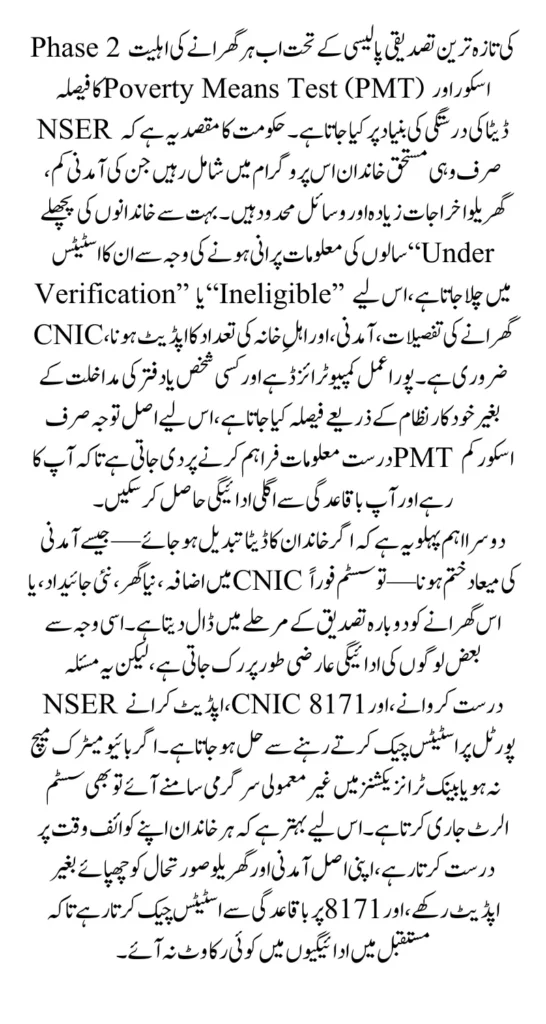
Many households get confused when they see their status change from eligible to under verification or even ineligible. This guide explains in clear and simple human language how Phase 2 eligibility works, how PMT is calculated, why some households face delays, and what steps can help you secure your payment without stress. By the end of this guide, every family will know how to check eligibility, update data, and resolve common verification issues.
You Can Also Read: 8171 Payment SIM Verification December
What Phase 2 Eligibility Actually Means
Phase 2 refers to the updated verification cycle introduced by BISP to recheck all household information before releasing the next payment. During this stage, the system compares your CNIC data, NSER record, and Poverty Means Test score to ensure that your financial situation fits within the required criteria. Households with low income, higher dependents, and fewer assets are usually approved instantly. However, those with outdated information or changes in income may temporarily go under verification until the system confirms their details.
This stage also prevents misuse of the program by ensuring that middle-income or ineligible families do not receive benefits meant for the poorest households. The entire process is automated and system-driven, meaning no agent, office worker, or third party can influence the outcome. The only way to ensure approval is to keep your CNIC and NSER data updated and maintain accurate financial information.
How the Poverty Means Test (PMT) Works
The PMT score is the foundation of Phase 2 eligibility. It uses several indicators to measure the economic stability of each household. A lower PMT score indicates poverty or financial vulnerability, increasing chances of approval. A higher score means that the household’s income, assets, or living conditions do not match BISP assistance criteria.
PMT covers multiple factors including housing conditions, utilities, dependents, education levels, employment type, and monthly income. Even small changes in income, new assets, or updated CNIC details can influence the PMT score. This is why many families who were previously eligible may now fall into under verification, as the system cross-checks updated information before confirming eligibility again.
You Can Also Read: Traffic Challan Psid Check Online And Pay Using Jazzcash
Key PMT Factors
- Type of home (rented or owned)
- Monthly household income and job type
- Electricity and gas usage patterns
- Number of dependents and elderly members
- Children enrolled in school
- Presence of disability in family
- Ownership of vehicles or land
- Bank transaction patterns
- Livestock or property ownership
Core Eligibility Requirements for Phase 2
To qualify for the upcoming BISP payment, each household must meet several criteria verified through the PMT and NSER system. These requirements ensure the program reaches the poorest and most deserving families across Pakistan. The system also gives priority to women-headed households such as widows, divorced mothers, and single mothers.
Eligibility Requirements
- CNIC must be original, valid, and updated
- Household must be registered in NSER with accurate details
- PMT score must fall within the eligible range
- Total household income should remain below the monthly threshold
- No member should hold a government job or pension
- Household should not own luxury vehicles or commercial properties
- Biometric verification must be completed
- Vulnerable groups such as elderly and disabled individuals receive higher priority
You Can Also Read: 8171 SMS Issue Attempt and Know Details
How to Check Your Phase 2 Eligibility
Checking your eligibility is simple and can be done in three different ways. It is important to check your status regularly because the system updates data frequently during December. Even if you were previously ineligible, updates may change your status to eligible once verification is completed.
1. Eligibility Check Through 8171 SMS
Send your CNIC number to 8171 from the SIM registered in your name. You will receive a message confirming whether you are eligible, under verification, or ineligible. If no message comes, it may mean your SIM is not linked with your CNIC or your data needs updating.
2. Eligibility Check Through 8171 Web Portal
Visit the official 8171 portal and enter your CNIC along with the captcha code. The portal will immediately display your eligibility status. This method is useful for checking updates multiple times during the verification period.
3. Verification Through BISP Office
If both SMS and portal show unclear results, visit your nearest BISP office with your CNIC. The team will check whether your NSER or PMT score needs correction and guide you on the next steps.
You Can Also Read: Solar Panel Scheme Online Apply 2025
Understanding What Your Status Means
Beneficiaries usually see one of three statuses, each carrying a specific meaning. Understanding these helps you decide the correct action instead of worrying or guessing.
Eligible
This means your PMT score, NSER record, and CNIC are confirmed. You will receive your payment when your district phase begins. Keep your CNIC and biometrics ready.
Under Verification
The system is checking your household information. This often happens when income, address, or family size was recently updated. Usually, this status clears automatically within a few days.
Ineligible
This means your PMT score or income has changed, or your CNIC has issues. You can still update your NSER and apply for re-verification to regain eligibility.
You Can Also Read: Ehsaas Program Registration 8171 NADRA Apply Online
Payment Schedule for December 2025
Below is the natural table showing when payments start across different regions:
| Province | Start Date | Duration | Method |
|---|---|---|---|
| Punjab | December 10 | 10 days | HBL Connect, Bank Alfalah |
| Sindh | December 12 | 12 days | Authorized centers |
| KPK | December 14 | 9 days | Banks and mobile units |
| Balochistan | December 15 | 8 days | Mobile camps |
| Remote Areas | Late December | Variable | Mobile payment units |
Beneficiaries must bring their original CNIC for payment collection. Photocopies or expired cards are not accepted at any center.
Why Payments Are Sometimes Stopped
Payments can be paused for several reasons, usually related to data issues. These pauses are temporary and can be resolved with simple steps. Most families face stoppages due to outdated NSER, expired CNIC, or incorrect fingerprint data.
Common Reasons
- CNIC expired or blocked
- Household income increased
- A family member started government employment
- Unreported assets detected
- Biometric mismatch
- Bank activity showing higher financial capacity
- NSER information not updated
You Can Also Read: BISP Missed Payment Details Complete Guide to Check & Withdraw
How to Update NSER and Fix Eligibility
NSER updates are available at designated survey centers where families can update their household details including income, dependents, and housing conditions. CNIC issues must be resolved through NADRA before your data can sync with BISP.
Steps to Fix Your Details
- Renew or verify CNIC
- Update family information in NSER
- Correct address, dependents, and income details
- Submit appeal if information does not reflect your true financial condition
- Recheck status through 8171 after updates
How to Avoid Problems in Future Payments
To maintain eligibility in future phases, households must actively manage their data. Regular checks and timely updates ensure that your PMT score remains accurate and payments continue without disruption.
Important Tips
- Keep CNIC updated
- Verify fingerprints at NADRA if they fail
- Update NSER after changes in family size
- Avoid large deposits or transactions if household income is low
- Check 8171 portal regularly during payment months
- Keep mobile number linked with CNIC
Conclusion
Phase 2 eligibility for the next BISP payment depends entirely on PMT verification and updated household information. Families that keep their CNIC, NSER, and income records accurate face no difficulty in receiving the December 2025 installment. Understanding how PMT works, why verification changes happen, and what steps to take ensures that your payment is never delayed or stopped. This guide provides all the essential details families need to stay eligible, avoid common errors, and continue receiving financial support during this crucial period.
You Can Also Read: Interest-free Business Loan Punjab: