BISP 933 District Issue Solved
The BISP 933 district issue has become one of the most frustrating problems for beneficiaries who rely on financial assistance to support their households. Many women have seen their payments withheld due to incorrect district information or mismatches recorded in the BISP database. This leads to payments being blocked or marked as “pending” in the HBL system, leaving beneficiaries confused because they cannot understand why their funds are stuck even after multiple attempts.
Fortunately, a complete home-based solution is now available that allows beneficiaries to resolve the 933 issue without visiting any office. This method includes verifying CNIC details, correcting district information, and updating the HBL routing system. The entire process can be completed from home through simple document submission, allowing beneficiaries to get their stuck funds deposited into their HBL or HBL Microfinance accounts quickly and safely. This service is especially helpful for women, elderly people, or individuals living in remote areas.
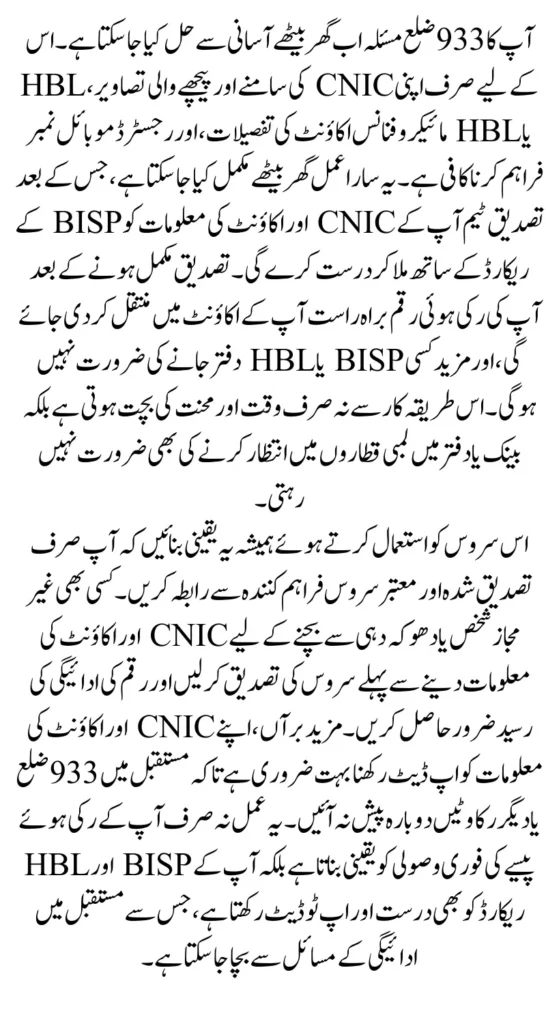
The home-based verification system has made it possible to correct district mismatches, update outdated information, and match CNIC data with the beneficiary’s account. It eliminates unnecessary travel, long queues, and repeated visits to BISP or HBL centers. With proper guidance and verification, your payment can be released into your account without any physical effort.
You Can Also Read: Canada Study Visas for 2026: IRCC Confirms 408,000 Permits
Understanding the BISP 933 District Issue
The 933 error typically appears when the district information in your CNIC does not match the district recorded in the BISP management system. When these two pieces of information do not align, the verification system automatically blocks your payment to prevent fraud or misrouting. This blockage results in your payment becoming stuck in the system, often appearing as pending, delayed, or unprocessed in your HBL account summary.
Another common reason for the 933 district issue is outdated information. Even if your CNIC district changed due to marriage, relocation, or update but the change wasn’t recorded in BISP’s database, the system generates the 933 error. This is why many women see this code more frequently than others, as district changes after marriage are not always updated on time.
The home-based correction process resolves these mismatches by verifying your CNIC’s front and back images, cross-checking your district, and matching it with BISP data. Once the correct district is verified and updated, your stuck payments can be released without interruption.
You Can Also Read: Social Protection Wallet Launch: New Payment System
Who Can Use This Home-Based Solution?
Any beneficiary facing the 933 district error message is eligible for this solution. Whether you are receiving payments through HBL, HBL Konnect, or HBL Microfinance, the service can help unlock your stuck funds. It is particularly helpful for users who cannot easily visit physical offices due to distance, mobility issues, or family responsibilities.
Beneficiaries who repeatedly see payment delays or account mismatches can also use this service, as the root cause is often incorrect district mapping or CNIC information. The verification team ensures your CNIC matches the BISP record and that your payment is routed to the correct HBL system.
Eligible Users
- BISP beneficiaries showing the 933 district error
- HBL and HBL Microfinance account holders
- Users stuck in HBL-to-HBL or microfinance-to-macrofinance routing
- Beneficiaries unable to visit BISP or HBL offices
- Women facing CNIC district mismatches after marriage
Documents Required for Fast Processing
Submitting the required documents is the most important step in getting your stuck payment released from the system. Only a few clearly scanned documents are needed to verify your identity and correct your district information. These documents help confirm that the applicant is the rightful beneficiary of the payment.
Providing clear and readable images ensures faster processing. If the CNIC picture is blurred or the text cannot be read properly, the verification process may face delays. It is recommended to take the photos in good light so every detail is visible.
You Can Also Read: Sindh Mamata Program Rs.5000 Per Phase Apply
Required Documents
- CNIC front side with clear visibility
- CNIC back side showing updated district
- HBL or HBL Microfinance account details
- Registered mobile number linked with CNIC
- Payment screenshot if available
Step-by-Step Process to Unlock Your Payment
The verification and payment release process is simple and designed for easy completion from home. It ensures that your CNIC information, district details, and HBL account mapping are corrected so that future payments do not get stuck again.
The first step is submitting your CNIC images and HBL account details. Once these documents are received, the verification team checks your district information against BISP records. After confirming the district correction, your account is updated in the system. This process ensures that your payment moves smoothly through the HBL system and is deposited into your active account.
Unlocking Steps
- Submit clear CNIC front and back images
- Provide your HBL or HBL Microfinance account details
- Verification team checks CNIC and district mismatch
- District information is corrected in the beneficiary profile
- Payment is released after successful mapping and verification
How HBL-to-HBL and Microfinance–Macrofinance Unlocking Works
Many beneficiaries do not know that HBL and HBL Microfinance operate on different internal systems. Sometimes, BISP payments are routed to the wrong network, causing the payment to get stuck. For instance, a payment meant for an HBL Microfinance account may land in a macrofinance system, requiring manual correction.
The unlocking process ensures that the money is properly mapped to the right account. The service checks your account type, corrects mismatches, and updates the routing path so that payments reach the correct system. This also helps avoid future payment delays, ensuring beneficiaries continue to receive funds smoothly.
The verification process ensures stability in the long run. Once the account type and routing are corrected, the beneficiary does not need repeated unlocking in future installments.
You Can Also Read: Parwaz Card Loans Up to 3 Million
Processing Time and Service Charges
The total time required to unlock your payment depends on the accuracy of your CNIC information. If your details are correct and clear, the process is usually completed quickly. In some cases, delays may occur due to incomplete documents or mismatches found during verification. However, the home-based system is designed to process everything as quickly as possible.
The service fee is kept affordable so that every beneficiary can access the solution without financial burden. You are informed about the charges before the process begins so there are no surprises later.
Processing Overview
- Typical processing time: 1–3 days
- Reasonable service charges
- Faster verification for urgent cases
Summary of BISP 933 Problem and Solutions
| Issue | Reason | Home-Based Solution |
|---|---|---|
| 933 District Error | CNIC-BISP district mismatch | CNIC verification + district correction |
| Payment Stuck in HBL | Routing mismatch | HBL-to-HBL unlocking |
| Microfinance Delay | Microfinance → Macrofinance routing | Account mapping and correction |
Common Issues and Their Solutions
Many beneficiaries face repeated verification failures due to very simple issues. In most cases, the root cause is incomplete information, poor-quality CNIC images, or outdated district entries. Identifying these issues early helps the verification team process your application faster.
If your mobile number is not registered with your CNIC, you may also face delays. Updating your mobile number in NADRA can prevent future issues. Similarly, expired CNICs often cause the system to flag payments, making it necessary to update CNIC details immediately.
You Can Also Read: BISP NSER Survey 2025
Most Common Issues
- Blurry or unreadable CNIC images
- District mismatch not updated in NADRA
- Mobile number not linked with CNIC
- Account temporarily blocked due to inactivity
How a Payment Was Released
A beneficiary facing the 933 district issue submitted her CNIC details from home. After receiving her documents, the verification team quickly identified a district mismatch between her CNIC and the BISP system. Once the district was updated, her HBL-to-HBL routing was corrected and the pending amount was released directly into her account.
Such real-life examples show how effective and helpful the home-based system is for beneficiaries. With accurate documents and proper verification, even long-pending payments can be recovered easily. Beneficiaries no longer need to visit crowded offices or rely on local agents.
Verification Confirmation She Received
- Payment confirmation message
- Transaction reference number
- Update confirmation screenshot
Support and Contact Guidelines
Before submitting your documents, always confirm that the service provider is verified and authorized. Sharing CNIC information with untrusted sources can be risky. Always ask for a receipt or confirmation message once your issue is solved.
It is also recommended to check your payment status regularly through the BISP portal or HBL Konnect app. Keeping your CNIC updated ensures that district mismatches do not occur again in the future.
What You Should Confirm Before Starting
- Verification method
- Time required for processing
- Service charges
- Receipt request after completion
You Can Also Read: Aghosh Program Reopens After Network Glitch Automatic