
BISP Validation 2025 Eligibility
BISP Validation 2025 Eligibility cycle is now underway across Pakistan, and every registered household must complete this crucial verification step to maintain their eligibility for the new payment withdrawal. This year’s validation is more detailed because the government aims to ensure that the Rs. 13,500 installment reaches families who are genuinely struggling with rising inflation, unemployment, and low income. The verification also ensures that all beneficiary records remain accurate and aligned with updated poverty indicators.
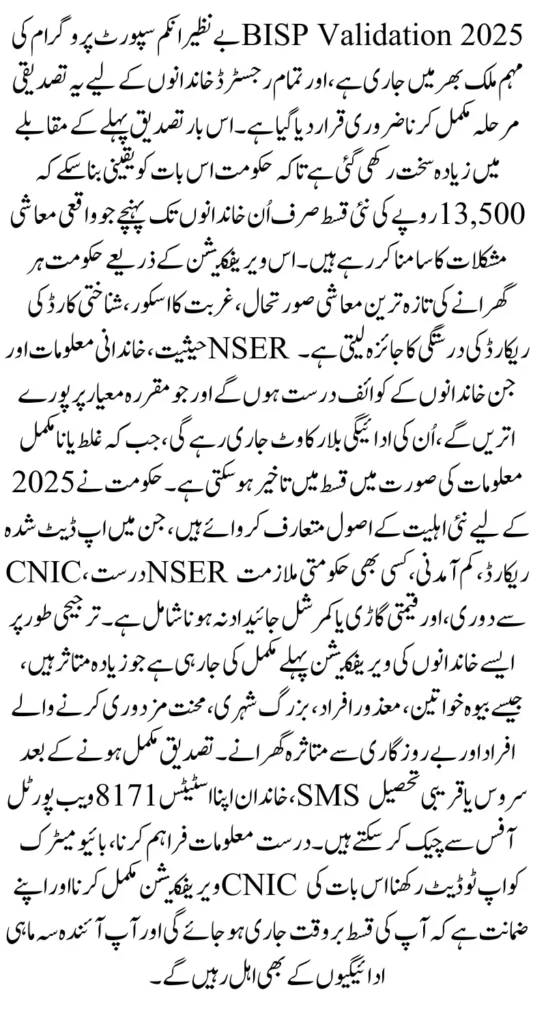
Through this guide, you will learn the complete process, including new eligibility requirements, step-by-step validation methods, reasons behind verification failures, how to update your CNIC and NSER information, and how to track your upcoming payment after approval. The article is written in simple and clean language so that all beneficiaries can understand the instructions without confusion.
You Can Also Read: How To Register BISP 8171
What BISP Validation 2025 Means for Beneficiaries
The 2025 validation cycle is more than a standard update; it is a large-scale national effort to reassess every household receiving BISP financial assistance. The purpose is to confirm whether the families registered in previous years still fall within the updated poverty score and remain eligible for government support. As economic conditions change, the status of each household may also change, and the validation helps maintain fairness within the program.
During this cycle, BISP verifies multiple factors such as the applicant’s CNIC status, family size, income trends, assets owned, and any changes recorded in the NSER database. Families who complete validation on time will continue receiving quarterly support without interruptions, while incomplete or incorrect information may temporarily delay payment release.
You Can Also Read: BISP 8171 Payment Verification 2025 For Withdrawal
Updated Eligibility Benchmarks Introduced for 2025
The government has refined the eligibility rules to ensure that the program remains targeted toward low-income families. These updated benchmarks help differentiate genuinely deserving beneficiaries from those whose socioeconomic conditions have improved.
The new eligibility benchmarks include:
- A valid and updated CNIC verified by NADRA
- Registration in the National Socioeconomic Registry (NSER)
- Household falling below the approved poverty score
- No current government job held by any family member
- No ownership of luxury vehicles or large-scale commercial property
- No active tax registration, filing or high-value bank transactions
Each of these benchmarks plays a vital role in determining whether a household still requires continued government assistance. Families failing to meet even one of these indicators may be placed under further review.
You Can Also Read: BISP 13500 December Payment Eligibility Status Check Online
Priority Groups During the 2025 Validation Cycle
While all applicants must complete validation, certain groups are given priority because they face greater economic challenges. These groups are considered vulnerable and are more likely to meet BISP’s poverty standards, making them a central focus of the 2025 cycle.
Priority categories include:
- Widows and households led by women
- Individuals with physical or mental disabilities
- Senior citizens without pensions or stable income
- Daily wage workers and laborers with irregular earnings
- Families heavily affected by unemployment or sudden economic burdens
These beneficiaries often rely entirely on government support. Prioritizing them ensures smoother validation and faster payment processing.
You Can Also Read: BISP 8171 Phase 2 District Payment List In December
How to Check Your BISP Validation 2025 Status
The government has provided multiple easy methods to help people verify their updated eligibility status. Beneficiaries can use whichever method suits them best, whether they have internet access or not.
1. Check Through the 8171 Web Portal
The web portal is the quickest way to view your validation results. Through the portal, families can immediately see whether their CNIC is verified, whether their NSER status is updated, and whether they qualify for the latest payment cycle.
To use the portal, enter your 13-digit CNIC, type the CAPTCHA code, and click Submit. The system instantly displays your eligibility status. This method is ideal for people who prefer digital verification and want faster updates.
2. Check Through the 8171 SMS Service
For individuals without smartphones or stable internet, the SMS service remains the most accessible option. Users simply type their CNIC number without spaces and send it to 8171. Within a short period, they receive a reply from BISP confirming whether their data is verified, pending, or requires updating at the nearest office. This method is widely used in rural areas due to its convenience and simplicity.
3. Check Through a Visit to the Nearest Tehsil Office
If the online records show incomplete or incorrect data, visiting a Tehsil BISP office becomes necessary. Staff members verify CNIC details, review household information, update missing records, and guide beneficiaries through any remaining steps. This method is useful for applicants whose data does not match NADRA or NSER records or those facing biometric issues.
You Can Also Read: BISP Digital Wallet SIM Distribution Locations Districts Wise
Comparing BISP Validation Methods
| Method | Best For | Requirements | Result Speed |
|---|---|---|---|
| 8171 Web Portal | Smartphone/internet users | CNIC + internet | Fast |
| 8171 SMS | Basic mobile users | CNIC only | Medium |
| Tehsil Office Visit | Incomplete or outdated records | CNIC + documents | Depends on crowd |
Step-by-Step Guide to Complete BISP Validation
Every household must complete these essential steps to finalize their validation successfully. The process ensures that your records match BISP’s updated system and that your payment is not delayed.
Step 1: Update NSER Dynamic Survey
The NSER survey plays a crucial role in determining your poverty score. During the dynamic survey, staff collect detailed information about your household, including home conditions, employment status, family members, and monthly earnings. Applicants must provide accurate data because incorrect entries can affect long-term eligibility. If your NSER information is outdated, this step becomes compulsory.
Step 2: Complete Biometric Verification
Biometric verification ensures transparency and prevents misuse of identity. At the Tehsil office, you will be asked to verify your fingerprints. If your fingerprints do not match, try other fingers or ask to use a different biometric device. In many cases, elderly individuals and manual laborers require multiple attempts due to worn fingerprints.
Step 3: Wait for Confirmation from 8171
Once your NSER and biometric data are approved, BISP sends a confirmation SMS. This message means your validation is complete and your eligibility has been updated. Only after receiving this confirmation can you check your payment withdrawal date.
You Can Also Read: BISP 8171 December 2025 Phase 2
Documents Required for Validation
Carrying the correct documents helps you avoid multiple office visits and speeds up the validation process. BISP may request different documents depending on your household category.
Documents usually required:
- Original CNIC of the applicant
- Mobile SIM registered under your CNIC
- NSER slip (if available)
- Children’s B-forms for Taleemi Wazaif updates
- Income details if requested for verification
Having all these documents ready ensures a smoother and faster experience at the Tehsil office.
Common Reasons for Validation Failure
Many beneficiaries face validation issues because of incomplete or outdated data. Understanding these reasons helps you fix problems early and avoid payment delays.
Common causes of failed validation:
- Expired or unverified CNIC
- Old or incorrect NSER information
- Income exceeding the approved poverty limit
- Biometric mismatches and repeated fingerprint failure
Most of these issues can be resolved by updating documents, completing the dynamic survey, or visiting another biometric center for verification.
You Can Also Read: 8171 Wallet Payment Is Not Showing On Web Portal
Who Qualifies After Passing BISP Validation 2025
Households that complete their validation successfully and meet the updated eligibility benchmarks will continue receiving full BISP benefits. These include the quarterly Kafalat stipend, children’s Taleemi Wazaif allowances, and additional relief assistance during emergencies or inflationary periods.
Successful validation confirms that the family still belongs to the low-income bracket and requires continued support from the government. Families that miss the validation deadline may experience delays until their information is updated.
How to Track Your Rs. 13,500 Payment After Validation
Once you receive the validation confirmation message, you can begin checking your payment status through the 8171 portal or SMS. Payments are usually released in scheduled phases, so checking regularly helps you stay updated.
Tips for smooth payment tracking:
- Save every message sent from 8171
- Keep your SIM active and avoid changing phone numbers
- Use the portal frequently during payment weeks
- Visit a Tehsil office only if you face technical issues
Tracking payments early ensures timely withdrawal and reduces the chances of missing important notifications.
Tips to Increase Your Approval Chances
Beneficiaries can improve their chances of successful validation by following a few important steps. These steps help ensure that all records are up to date and match official databases.
Helpful tips include:
- Keep your CNIC valid at all times
- Ensure your mobile SIM is properly registered in your own name
- Provide accurate household data during the NSER survey
- Carry all necessary documents when visiting the office
- Regularly check 8171 messages and avoid deleting them
Following these guidelines can significantly reduce the chances of rejection or delay.
You Can Also Read: BISP 8171 Payment Notification Delay December 2025
Conclusion
The BISP Validation 2025 cycle is essential for maintaining accurate records and ensuring that government support reaches households facing real financial hardship. By completing NSER updates, verifying your CNIC, ensuring correct biometric records, and checking eligibility through the official channels, you can secure uninterrupted access to your Rs. 13,500 payment and future installments