
Canada Study Visas for 2026
Canada Study Visas for 2026 Canada has officially released its international student permit plan for 2026, and the numbers show a major policy shift that will impact thousands of students worldwide. The Immigration, Refugees and Citizenship Canada (IRCC) confirmed that it will issue a total of 408,000 study permits next year as part of its broader strategy to reduce the share of temporary residents in the country to under 5 percent by the end of 2027. This move reflects a more controlled and focused approach to international education, aiming to balance economic benefits with the growing pressure on housing and public services.
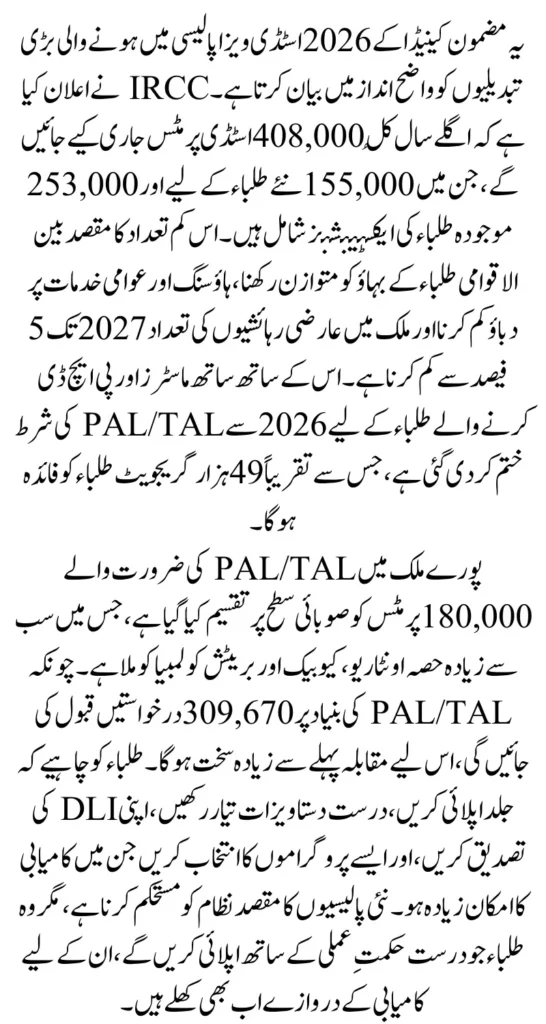
These new measures create both opportunities and challenges for applicants, depending on their academic level, province of choice, and institutional category. Students planning to apply for 2026 now need to understand not only the permit numbers but also the updated PAL/TAL requirements, exemptions for graduate students, and provincial allocations. This detailed guide explains every key point so applicants can prepare a strong and timely application.
You Can Also Read: Social Protection Wallet Launch:
Canada’s 2026 Study Permit Targets Explained
IRCC has set the total number of permits at 408,000, representing a significant adjustment from previous years. Out of this total, 155,000 permits will be issued to new incoming students, while 253,000 will be provided to students who are continuing their studies through extensions. This split shows that Canada is prioritizing stability for students already inside the country while slowly reducing the growth of new arrivals.
This plan reflects a broader national objective to ensure sustainable population growth. Over the past few years, Canada saw a sharp rise in international student numbers, which contributed to housing shortages and increased strain on local resources. By lowering the number of new permits and supporting more extensions, IRCC aims to balance student demand with provincial capacity and long-term development goals.
You Can Also Read: Sindh Mamata Program Rs.5000 Per Phase Apply
Key points from IRCC’s 2026 target
- Total permits: 408,000
- New permits: 155,000
- Extensions: 253,000
- Reduction from 2025 target: 7 percent
- Reduction from 2024 target: 16 percent
Understanding New Permits vs Extensions
The difference between new permits and extensions plays an important role in Canada’s student management strategy. New permits are issued to students who are entering Canada for the first time to begin their academic journey. This includes those applying for undergraduate programs, postgraduate diplomas, language courses, and vocational training. Because the number of new permits is now reduced, applicants should expect higher competition for acceptance into institutions and provincial allocations.
Extensions, on the other hand, are provided to students already studying in Canada who wish to continue their education or need more time to complete their program. The large number of extension allocations ensures that current students are not negatively impacted by permit limits. IRCC wants to protect learners who are already contributing academically and socially, allowing them to complete their studies without uncertainty.
You Can Also Read: Parwaz Card Loans Up to 3 Million
Who typically applies for extensions
- Students finishing their final semester
- Students switching to a higher level program
- Those needing extra time due to academic or program requirements
Major Update: PAL/TAL Exemption for Graduate Students
One of the most important changes for 2026 is the new exemption from Provincial or Territorial Attestation Letters (PAL/TAL) for certain groups. Starting January 1, 2026, master’s and PhD students at publicly recognized Designated Learning Institutions (DLIs) will no longer require a PAL/TAL to apply for a study permit. This change benefits around 49,000 graduate students annually and offers a smoother, faster application process for those involved in advanced research and innovation.
The exemption also includes several other categories such as primary and secondary school students, vulnerable groups, and applicants who are renewing their study permit at the same level and institution. This exemption recognizes the academic importance of graduate research and acknowledges that these students often contribute to Canada’s innovation, technological growth, and skilled labor pipeline.
You Can Also Read: BISP NSER Survey 2025 For New People Registration
Students exempt from PAL/TAL
- Master’s and doctoral students at public DLIs
- Primary and secondary school students
- Government-priority and vulnerable groups
- Current students renewing at the same DLI and same level
Province-Wise PAL/TAL Required Permits for 2026
For students who still require a Provincial or Territorial Attestation Letter, Canada has allocated a total of 180,000 study permits across provinces and territories. The distribution depends on provincial population, historical approval rates, and the number of educational institutions operating in each province. These allocations are important because they determine how competitive each region will be for undergraduate applicants and college-level students.
Below is the natural placement of the required table within the article:
PAL/TAL Required Study Permits by Province (2026)
| Province/Territory | PAL/TAL Permits 2026 |
|---|---|
| Ontario | 70,074 |
| Quebec | 39,474 |
| British Columbia | 24,786 |
| Alberta | 21,582 |
| Manitoba | 6,534 |
| Saskatchewan | 5,436 |
| Nova Scotia | 4,680 |
| New Brunswick | 3,726 |
| Newfoundland & Labrador | 2,358 |
| Prince Edward Island | 774 |
| Yukon | 198 |
| Northwest Territories | 198 |
| Nunavut | 180 |
| Total | 180,000 |
Canada will also accept up to 309,670 PAL/TAL-related applications, meaning more students will apply than the total number of available spots. This increases competition and encourages students to apply as early as possible.
You Can Also Read: Aghosh Program Reopens After Network Glitch Automatic
How These Changes Affect International Students
The new permit reductions and PAL/TAL requirements will influence how students prepare, choose institutions, and plan their applications. These changes aim to reduce pressure on community housing, public services, and transportation networks, especially in large cities such as Toronto, Vancouver, and Montreal. However, the reduced number of permits also means students must be more strategic in selecting a province or program to improve their chances of approval.
Many institutions may adjust their admission processes, increase academic requirements, or place more emphasis on proof of financial stability. Applicants will also need to ensure their documentation is stronger and more consistent than before, as competition grows for a smaller number of available spots.
Expected effects on students
- Higher competition for undergraduate and college programs
- Faster processing for eligible graduate applicants
- Increased importance of selecting the right DLI
- More strategic applications based on provincial allocations
Application Tips for Students Applying in 2026
With limited permits available, students must plan their applications carefully. Applying early and preparing accurate documents can significantly increase approval chances. It is also important to verify whether your chosen program requires PAL/TAL and confirm that your DLI is publicly designated, especially if you are targeting the PAL/TAL exemption for graduate studies.
Students should also pay close attention to financial documentation, study plans, and ties to home country, as these factors greatly influence the approval outcome. Avoiding mistakes, inconsistencies, and weak explanations in your application will be essential under the stricter 2026 environment.
You Can Also Read: Punjab Matric & Inter Exam Dates 2026 Released
Practical tips for a successful application
- Apply early to secure a place within provincial limits
- Choose a public DLI to increase approval chances
- Confirm if your program requires PAL/TAL
- Prepare a strong study plan with clear academic goals
- Maintain updated financial proof and academic records
Conclusion
Canada’s study permit framework for 2026 represents a major policy adjustment aimed at bringing balance to the country’s international student system. With 408,000 total permits, stricter allocations, and new PAL/TAL exemptions for graduate students, applicants will need to stay informed and proactive. These changes are designed to support both national priorities and high-quality education standards, while still offering opportunities for students who prepare well and understand the new structure.
Students targeting Canada for 2026 should begin their preparation early, understand the requirements of their chosen program, and take advantage of exemptions where possible. With the right planning and awareness of provincial limits, it is still possible to secure a study permit and build a strong academic future in Canada.